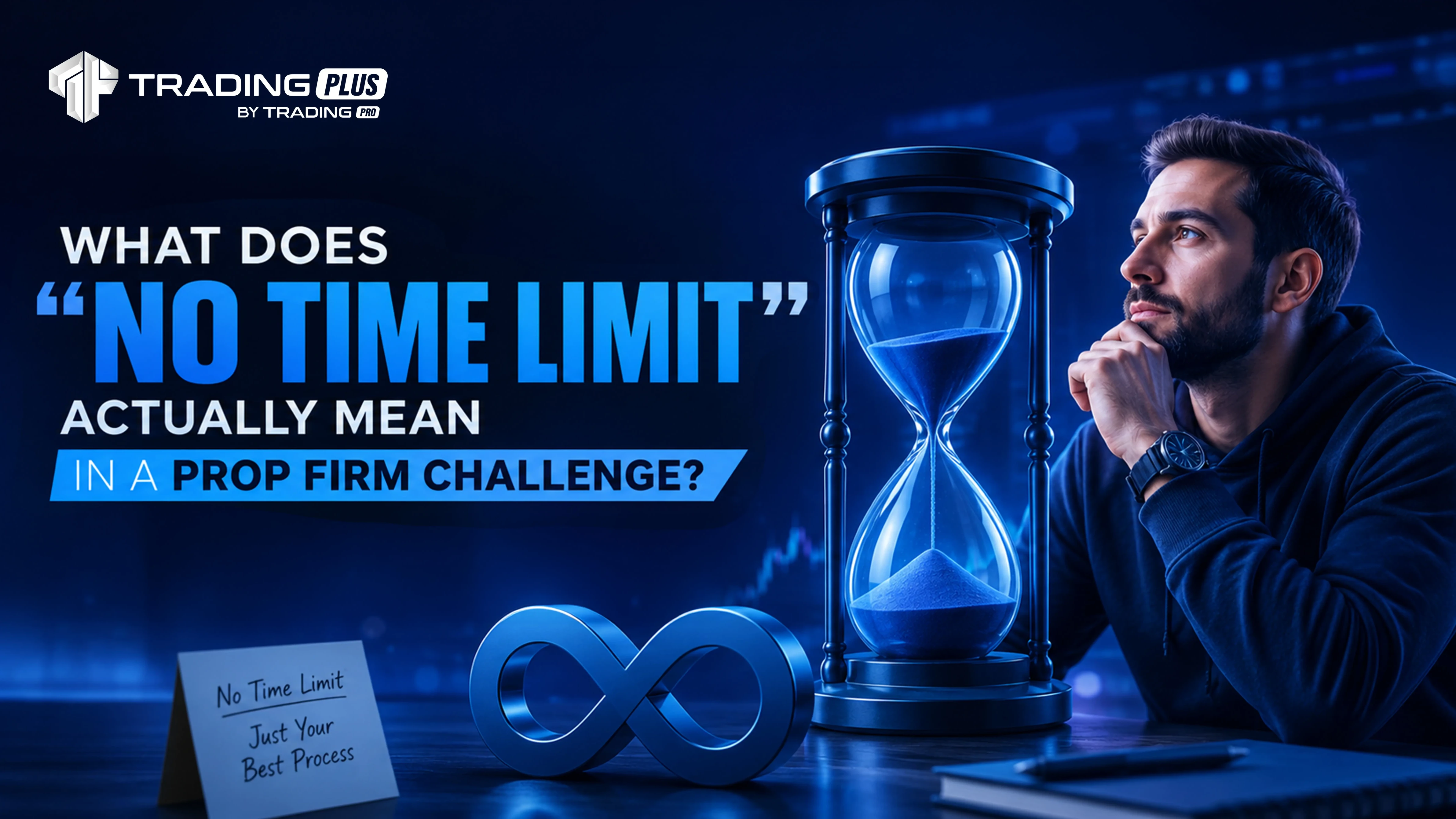
What Does "No Time Limit" Actually Mean in a Prop Firm Challenge?
If you've been researching prop firm challenges, you've probably seen firms advertising "no time limit" on their evaluations. It sounds straightforward, but a lot of new traders misread what it actually means and end up either overcautious or caught off guard by a rule they didn't know existed.
This guide breaks it down clearly. We'll look at how prop firm challenge structures have changed over the years, why removing the time limit matters more than most traders realise, and the one important catch that "no time limit" does not mean.
The Old Way: 30-Day Challenge Windows
For most of prop trading's history, challenges came with a hard deadline. Thirty days was the industry standard. You had one calendar month to hit your profit target while staying within the loss rules. If you didn't make it, the evaluation ended and you had to start again.
The logic behind it made sense from the firm's perspective. A time limit filters for traders who are active and consistent enough to perform under pressure. But in practice, it created a problem that had nothing to do with actual trading ability.
The 30-day pressure trap: With two weeks left and only half the profit target reached, a trader who was performing perfectly well starts to rush. Position sizes go up. Trades are forced on setups that aren't quite there. The evaluation that was going fine suddenly spirals in the final week because the clock created urgency that the market didn't.
This wasn't a small issue. Countless traders failed evaluations not because their strategy didn't work but because the deadline pushed them into decisions they would never have made without it. The time limit was testing stress tolerance more than it was testing trading skill.
The New Way: Unlimited Challenge Days
No time limit challenges remove the deadline entirely. You still have a profit target to hit and loss rules to stay within, but you can take as many trading days as you need to get there. A week, a month, three months. The evaluation stays open until you either pass or breach a risk limit.
This structural change is more significant than it might appear on paper.
What unlimited time actually gives you: The freedom to wait for high-quality setups rather than filling your trading days with activity just to make the clock feel worthwhile. Every trade can be taken because it genuinely meets your criteria, not because you're running out of time.
For traders who have a solid strategy but a naturally lower trade frequency, the old 30-day model was actively working against them. A swing trader who takes three or four high-conviction setups per week was at a structural disadvantage compared to a day trader taking ten positions daily. Unlimited time levels that playing field completely.
The Psychological Benefit: Fewer Emotional Trades
Removing the time pressure doesn't just change your schedule. It changes how you think while you're trading, and that difference shows up in your results.
Revenge Trading Drops
Revenge trading happens when a loss triggers an emotional response and you immediately open another position to make it back. One of the most common triggers for revenge trading in a timed challenge is the feeling that you've wasted a day and need to recover before the window closes.
When there's no closing window, that pressure disappears. A bad session is just a bad session. You close the platform, rest, and come back tomorrow. The account is still there. The evaluation is still live. Nothing has been lost except one day's performance, which will average out across the weeks ahead.
Over-Leveraging Reduces
The other behaviour that time limits encourage is over-leveraging. Traders who are behind on their profit target with days remaining start increasing position sizes to close the gap faster. It's a rational response to a deadline but a destructive one in terms of risk management.
Without a deadline, there's no gap to close urgently. Your position sizes are determined by your strategy and your risk rules, not by how much time is left on a countdown. The result is more consistent sizing and more consistent results.
The shift in mindset: A timed challenge asks "how much can I make before this ends?" An unlimited challenge asks "what is the right trade right now?" That second question produces better traders.
The Important Catch: No Time Limit Is Not No Activity
This is the part most traders miss when they first read about no time limit challenges. Not having a deadline does not mean you can leave the evaluation dormant for months.
Almost every prop firm that offers unlimited challenge time also has an inactivity rule. The specific terms vary but the principle is consistent: if you go a certain number of consecutive calendar days without placing a trade, your account is flagged or closed.
Typical inactivity thresholds: Most firms set this between 14 and 30 consecutive days without a trade. Some are stricter. Check your specific challenge terms before you take an extended break from the markets.
This rule exists for a practical reason. A funded account sitting idle while the firm waits indefinitely is a cost to the business. The inactivity threshold ensures that traders in the evaluation are genuinely engaged with the markets, not just holding an account open as a future option.
For most active traders, the inactivity rule is never a concern. But if you're planning to take an extended holiday, pause for personal reasons, or step away from the markets for a few weeks, it's worth checking whether your challenge account requires even a single trade within that window to remain active.
Simple rule to remember: No time limit means no deadline to hit your target. It does not mean no requirement to trade. Stay engaged with the markets and the inactivity rule will never affect you.
Why This Is the Best Structure for Swing Traders
Swing traders hold positions for anywhere from a few days to several weeks, entering on longer timeframes and waiting for larger price moves to play out. They typically take fewer trades per month than day traders or scalpers, but each trade carries more weight.
Under a 30-day challenge, swing traders faced a genuine structural problem. A setup that forms on a weekly chart might take ten to fourteen days to reach its target. Opening and managing that trade correctly, within a 30-day window that's also demanding a profit target, created a specific kind of pressure that had nothing to do with whether the trade was good or not.
- A setup that takes two weeks to play out uses up half the evaluation window on a single position.
- If the trade moves against you temporarily before recovering, the drawdown pressure feels amplified by the remaining time.
- Holding through normal retracements becomes harder when the clock is running.
- The temptation to close early and take partial profit before the deadline grows as days run down.
The no time limit model resolves every one of these. A swing trader can open a position, hold it for twelve days while it works, close it at the full target, and then wait another week for the next clean setup. The entire process plays out exactly as it would on a personal trading account, with no artificial pressure from an evaluation deadline.
The bottom line for swing traders: No time limit challenges are the only challenge structure that genuinely accommodates a swing trading style. If you trade higher timeframes and hold positions for days or weeks, this is the model you should be looking for.
TradingPLUS Challenges: Built Around How You Actually Trade
At TradingPLUS, our challenge structure is designed to evaluate real trading ability, not how well someone performs under artificial deadline pressure. That means no 30-day countdown, no urgency to force trades that aren't there, and no evaluation clock that works against your natural style.
Whether you're a swing trader working the daily charts or an intraday trader who prefers to build a track record slowly and methodically, the TradingPLUS evaluation gives you the time and space to trade the way you've practised. Hit the target at your pace. Get funded. Keep trading.
Start Your TradingPLUS Challenge Today
Stay Connected With TradingPLUS
Join traders across the globe sharing challenge strategies, market insights, and real funded account experiences every day.
Discord |Facebook | LinkedIn | Telegram
Frequently Asked Questions
What does no time limit mean in a prop firm challenge?
It means there is no deadline to complete the evaluation. You can take as many trading days as you need to hit the profit target, as long as you stay within the loss rules and remain active within the firm's inactivity policy. There is no 30-day or 60-day window counting down against you.
Is there really no time limit on TradingPLUS challenges?
Yes. TradingPLUS challenges do not have a fixed end date. The evaluation remains open until you either hit the profit target and pass, breach a risk rule and fail, or trigger the inactivity threshold by going too long without placing a trade.
What are the inactivity rules on a no time limit challenge?
Even with unlimited challenge time, most prop firms including TradingPLUS require traders to place at least one trade within a set number of consecutive days. Check your specific challenge terms for the exact threshold. Going inactive for extended periods without trading can result in the account being closed.
Are no time limit challenges better for swing traders?
Yes, significantly. Swing traders hold positions for days or weeks and typically take fewer trades per month than day traders. A 30-day challenge window creates artificial pressure that works directly against a swing trading approach. No time limit challenges allow swing traders to operate naturally without being penalised for their style.
Does no time limit mean I can take as long as I want?
You can take as long as you need to hit the profit target, but you must remain active in the markets. Inactivity rules still apply on unlimited challenges. As long as you're trading regularly and within the risk rules, the evaluation will stay open until you pass.
What are the rules for passing a no time limit prop firm challenge?
The core rules are the same as any challenge: hit the profit target, stay within the daily loss limit, stay within the maximum drawdown, and meet the minimum trading day requirement if one applies. The only thing that changes is that you're not racing against a calendar to do it.