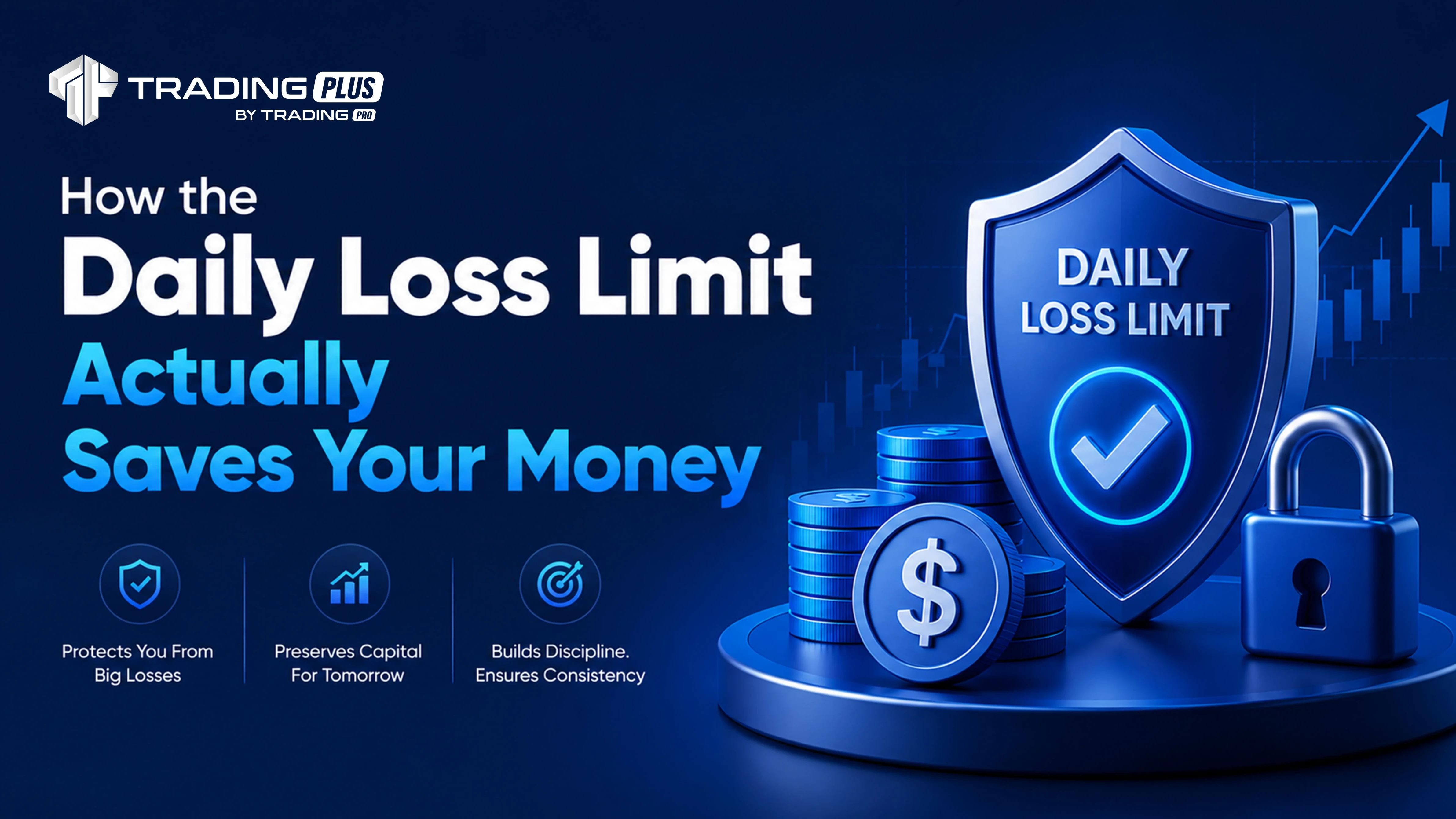
How the Daily Loss Limit Actually Saves Your Money
Almost every beginner who starts a prop firm challenge has the same reaction to the daily loss limit at some point. It feels like the rule that's working against you. You're down for the day, you can see a setup forming that you're sure would turn things around, and the platform won't let you touch it. Frustrating doesn't begin to cover it.
Here's the thing though. That rule isn't there to stop you from making money. It's there because of what tends to happen on the days you're most tempted to ignore it.
What a Bad Day Actually Looks Like Without a Limit
Picture trading without any daily cap on your losses. You take a hit early in the session, maybe down 2% on the account. Annoying, but recoverable. You take another trade to make it back. That one goes against you too. Now you're down 4%, and the voice in your head isn't asking whether the next trade is a good setup. It's asking how to get back to where you started.
This is the exact mechanism behind almost every account-destroying day in trading. Not one bad trade. A sequence of decisions made while trying to recover from the first one. Each loss makes the next trade feel more urgent, and urgency is the enemy of good decision-making in markets.
Without something forcing a stop, there's no natural point where this sequence ends except total exhaustion or running out of capital. The daily loss limit puts a hard floor under that spiral before it gets anywhere close to either outcome.
The Simple Version: One Bad Day Can't Wipe You Out
Say you're trading a $10,000 funded account with a standard 5% daily loss limit. That's $500. Once you've lost that much in a single day, the system stops you. You can't place another trade until the next session opens. That's the entire mechanism. There's no judgement call, no exception, no override.
Without that limit, what's stopping a trader from losing $2,000 or $3,000 in one session once the emotional spiral kicks in? Nothing structural. Just self-control, which is exactly the thing that erodes fastest after a string of losses. The daily loss limit isn't there because the firm doesn't trust you. It's there because almost nobody trusts themselves correctly in the middle of a losing streak, and the rule doesn't care how confident you feel in the moment.
A trader who hits the daily loss limit at $500 still has $9,500 left to trade with tomorrow. A trader without that limit, on a bad enough day, might not.
Why This Protects You Even When You Disagree With It
The hardest moment to appreciate the daily loss limit is exactly the moment it activates. You're convinced the market is about to turn in your favour. You can see the setup. Letting that conviction go untested feels like leaving money on the table.
This is worth sitting with for a second, because it's the part most beginners get wrong. The feeling of certainty after a loss is not a reliable signal. It's adrenaline and frustration dressed up as a trading opinion. Professional traders who've been doing this for years still fall into this trap occasionally. The difference is they've built rules around themselves specifically because they know the feeling lies to them in this exact situation.
The daily loss limit does that rule-building for you automatically. You don't have to trust your own judgement at the worst possible moment to make that judgement. The system makes the decision before the emotional spiral has a chance to take over.
It also protects your trading psychology, not just your balance
There's a quieter benefit here that doesn't get talked about as much. Every time you stop trading after hitting the daily limit instead of pushing through, you're reinforcing a habit. You're teaching yourself that bad days end, that they don't need to be fixed in the same session, and that capital preservation matters more than being right today.
Traders who never develop this habit, because they've never traded under a hard daily stop, tend to carry that vulnerability with them even after they're managing larger accounts. The discipline the limit forces on you early is discipline you'll lean on for the rest of your trading career.
How It Connects to Your Maximum Drawdown
The daily loss limit doesn't work alone. It's paired with the maximum drawdown rule, which caps how much your account can fall from its peak overall, not just in a single day.
Think of the daily limit as the rule that stops the bleeding fast, and the max drawdown as the rule that stops a string of slowly accumulating bad days from quietly draining the account over weeks. Together they make sure no single bad moment, and no slow accumulation of smaller bad moments, can take the account down entirely.
Understanding how these two rules work together gives you a much clearer picture of why prop firms structure accounts the way they do, and how to trade in a way that respects both without feeling boxed in by either.
How to Make the Daily Loss Limit Work For You
Once you stop seeing the rule as an obstacle, you can actually use it strategically.
- Set your own limit below the firm's. If your daily loss limit is 5%, set a personal stop at 2% or 3%. You'll rarely hit the firm's hard limit and you'll build the habit of stopping even earlier than required.
- Treat hitting the limit as information, not failure. A day where you hit your loss limit is telling you something, maybe about market conditions, maybe about your own state of mind. Review it instead of just being frustrated by it.
- Walk away completely once you're stopped. Close the platform. Don't watch the charts. Watching a market you can't trade while still emotionally invested in the day's result undoes the protection the limit just gave you.
- Remember tomorrow is a clean slate. The daily limit resets every session. A bad day doesn't follow you into the next one unless you let it.
The Rule You'll Eventually Thank
Almost every trader who's been doing this for a while has at least one story about a daily loss limit saving them from a much worse outcome. Usually it's a day they didn't appreciate being stopped at the time, and only understood months later when they looked back at how that session would have gone if they'd kept pushing.
If you're newer to prop trading and still feel the friction every time that limit kicks in, that's a normal stage to go through. The rule isn't designed to be comfortable. It's designed to keep you in the game long enough to get good at it.
Start Your TradingPLUS Challenge Today
Join the TradingPLUS Community
Talk to traders who've been exactly where you are with the daily loss limit and hear how their perspective on it changed over time.
Instagram|Discord |Facebook | LinkedIn | Telegram
Frequently Asked Questions
Why do prop firms have a daily loss limit?
The daily loss limit exists to stop a single bad trading session from causing serious damage to the account. It interrupts the cycle of revenge trading and emotional decision-making that tends to follow an early loss, capping the damage before it compounds into something much larger.
Is the daily loss limit bad for traders?
No, even though it can feel that way in the moment. The limit protects traders from their own worst decisions, which are most likely to happen right after a loss when emotions are highest. Traders who respect the limit tend to preserve their accounts and their trading psychology far better than those without any daily stop at all.
What happens when I hit my daily loss limit?
Trading is paused for the rest of that session. You cannot place further trades until the next trading day begins. The limit resets daily, so a difficult session does not carry over or affect your ability to trade normally the following day.
How is the daily loss limit different from the maximum drawdown?
The daily loss limit caps how much you can lose in a single day and resets every session. The maximum drawdown is cumulative, tracking the total loss from your account's highest point over the life of the account, and does not reset. The two rules work together to protect against both sudden and gradual losses.
Should I set my own loss limit lower than the firm's rule?
Many experienced traders do exactly this. Setting a personal stop below the firm's official limit means you rarely come close to the hard rule and builds a habit of disciplined risk management that serves you well beyond any single account.