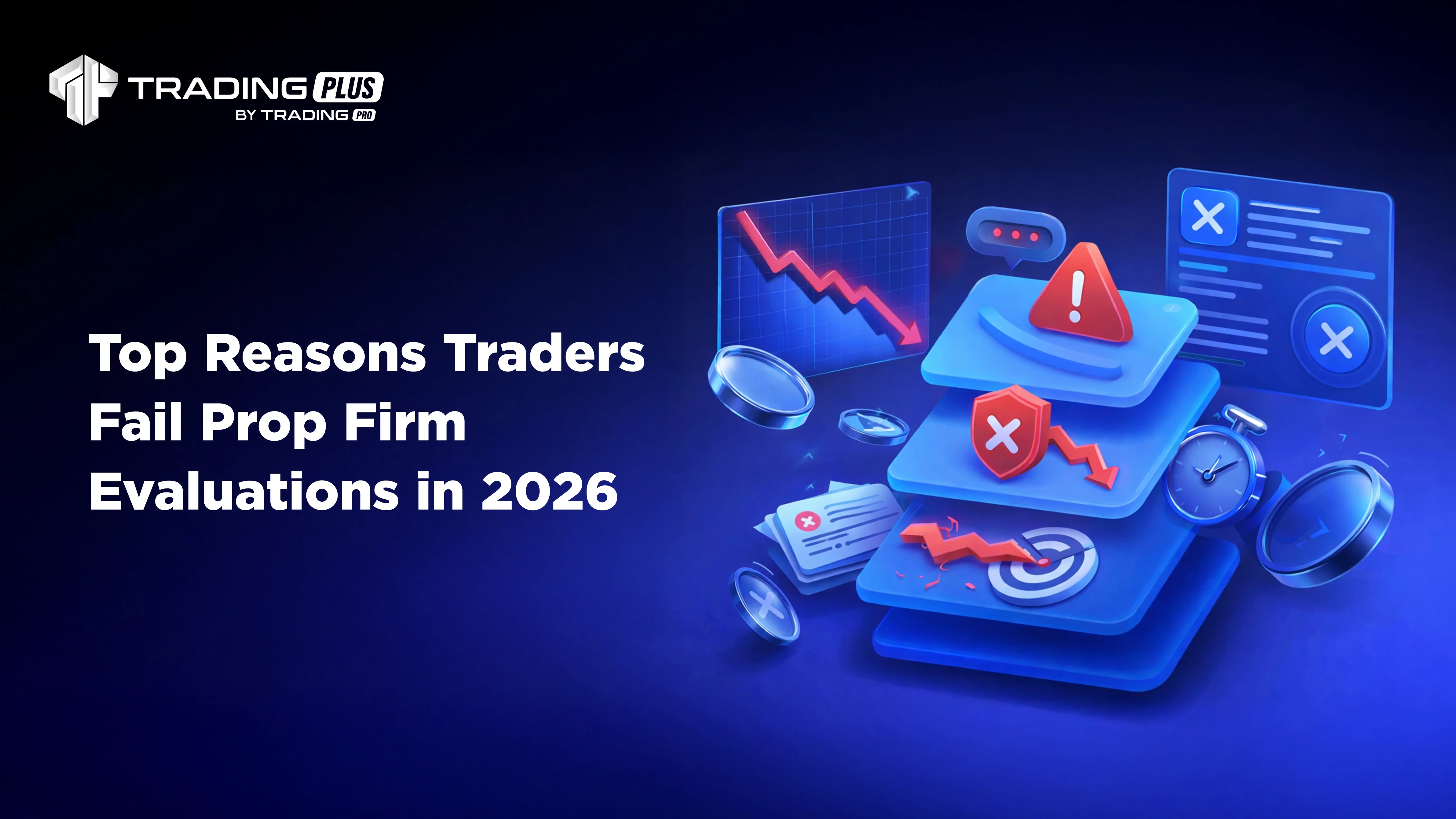
Top Reasons Traders Fail Prop Firm Evaluations in 2026
Prop firm evaluations are designed to identify traders who can manage risk, follow rules, and perform consistently under pressure. Yet, despite having solid strategies, most traders still fail evaluations.
In 2026, the reasons for failure are rarely technical. They are behavioral, psychological, and structural.
Below are the most common reasons traders fail prop firm evaluations, and how disciplined traders avoid them.
1. Overtrading to Hit Profit Targets Faster
One of the biggest mistakes traders make is trying to pass the evaluation as quickly as possible.
This often leads to:
- Taking low-quality setups
- Trading outside of planned sessions
- Forcing trades that don’t align with the strategy
Prop firm evaluations reward consistency, not speed. Traders who slow down dramatically increase their chances of success.
2. Risking Too Much Per Trade
Many traders underestimate how quickly drawdowns can compound.
Common risk mistakes include:
- Increasing position size after losses
- Ignoring maximum daily loss rules
- Using inconsistent risk sizing
In 2026, successful evaluation traders typically risk less than 0.5% per trade, allowing them to survive normal losing streaks.
3. Ignoring Drawdown Rules
Drawdown rules are the most misunderstood aspect of prop firm trading.
Traders often fail by:
- Letting losses run
- Holding trades too long
- Not understanding trailing drawdowns
Once drawdown rules are breached, evaluations end, regardless of overall profitability.
4. Trading During High-Impact News Events
News volatility remains one of the fastest ways to fail an evaluation.
Common mistakes:
- Trading interest rate decisions
- Entering positions during CPI or employment data
- Holding trades through unpredictable news
In 2026’s fast-moving markets, news trading dramatically increases slippage and execution risk.
5. Switching Strategies Mid-Evaluation
Many traders abandon their plan after:
- One or two losing trades
- A small drawdown
- Seeing another trader succeed differently
Switching strategies mid-evaluation leads to inconsistency, confusion, and emotional trading.
Funded traders commit to one strategy and execute it repeatedly.
6. Emotional Trading After Losses
Revenge trading is a leading cause of evaluation failure.
It often appears as:
- Immediate re-entries
- Doubling risk to recover losses
- Ignoring trade rules
Emotional responses remove structure and prop firm trading punishes lack of discipline.
7. Treating Prop Accounts Like Personal Accounts
Prop firm accounts require a different mindset.
Common errors:
- Overleveraging
- Holding trades longer than allowed
- Ignoring firm-specific rules
Successful traders treat prop capital with more respect than personal capital.
8. Lack of a Clear Daily Trading Routine
Traders without routines tend to:
- Trade randomly
- Chase market moves
- Miss optimal setups
A simple routine includes pre-market planning, execution window, and post-trade review dramatically improves evaluation performance.
What Successful Traders Do Differently
Traders who pass evaluations consistently:
- Trade less, not more
- Focus on risk first
- Accept slow progress
- Stop trading when conditions aren’t ideal
- Respect every rule, every day
Passing an evaluation is about avoiding mistakes, not maximizing wins.
Final Thoughts
Most prop firm evaluations are not failed because traders lack skill, the reason they are failed is because traders ignore structure, discipline, and risk control.
Trade With Discipline at TradingPLUS
Ready to approach prop trading the professional way?
Follow TradingPLUS on Social Media:
Instagram | Facebook | LinkedIn | Telegram