Why the Second Step of a Prop Firm Challenge Is Actually Easier
Most traders approach Step 2 of a prop firm evaluation with more anxiety than Step 1. You've already come this far. You don't want to blow it now. The stakes feel higher because you're closer to the funded account.
Here's the thing that most firms don't explain loudly enough: Step 2 has a lower profit target than Step 1. You need to make less money to pass. The risk rules are the same. The time pressure is the same. But the number you're chasing is smaller, and that changes everything.
This guide breaks down exactly why Step 2 is structured the way it is, what the numbers actually look like on a real account, and how to approach the second phase with the right mindset to pass it cleanly.
The Numbers Side by Side
Let's use a $10,000 account as the example because it's the most common starting point for new prop traders. The targets are straightforward once you see them in dollar terms.
PHASE 1 — Step One
Profit target: 10% which equals $1,000 on a $10,000 account.
You need to grow the account by $1,000 while staying within the daily loss limit and maximum drawdown rules. This is the higher bar. The firm is asking you to demonstrate that you can generate meaningful returns on their capital.
PHASE 2 — Step Two
Profit target: 6% which equals $600 on a $10,000 account.
You need $400 less than Step 1 to pass. Same account size, same loss rules, same trading conditions. The only thing that changed is the target, and it moved in your favour.
In plain numbers: Step 1 asks for $1,000. Step 2 asks for $600. If you passed Step 1, you already proved you can do more than what Step 2 requires.
Why Does Step 2 Have a Lower Target?
The two-step evaluation is designed with a specific purpose at each phase. They're not the same test repeated twice.
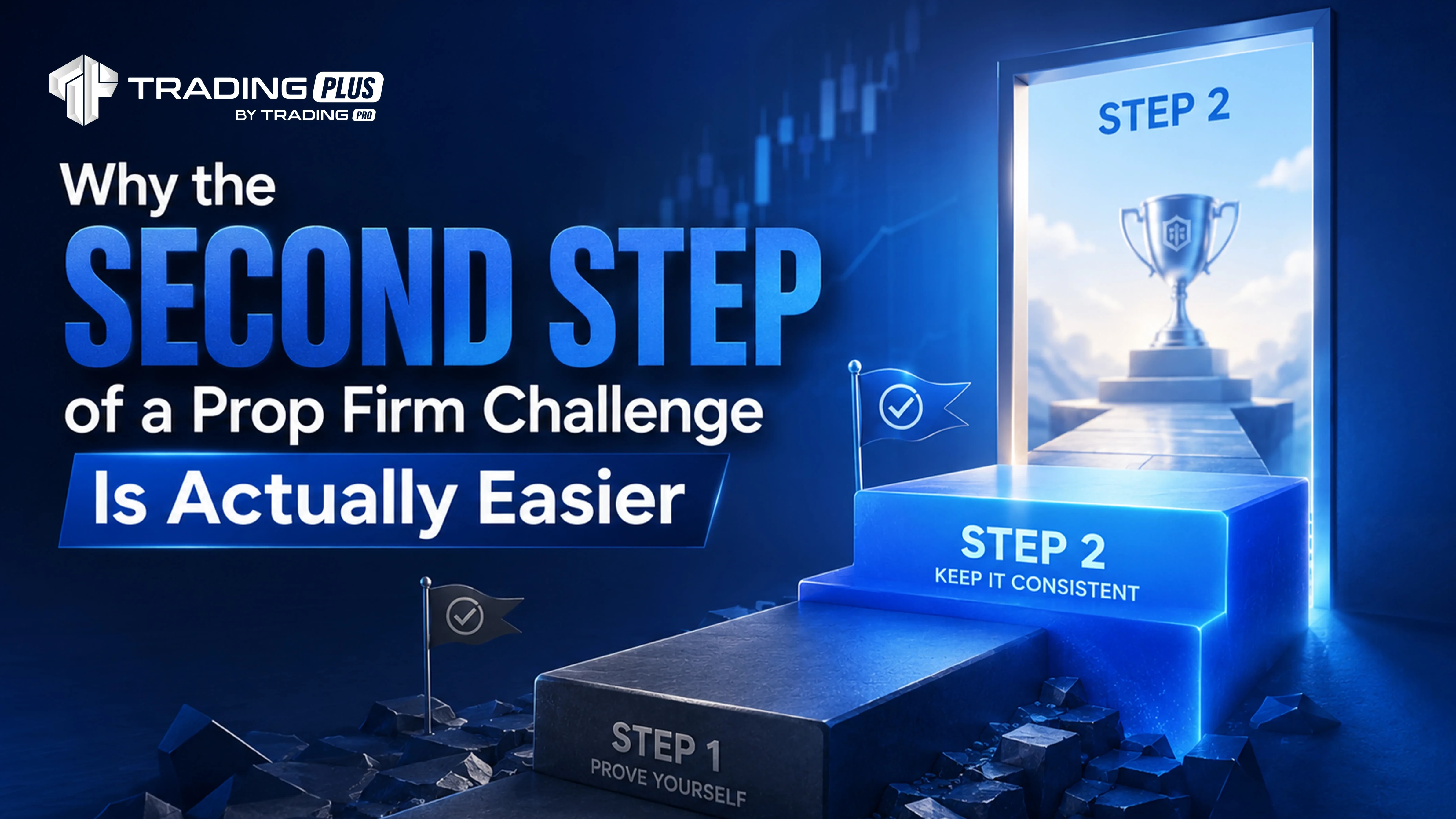
Step 1 is about capability. Can this trader generate real returns? Can they hit a meaningful profit target while managing risk? The 10% target filters for traders who understand how to grow a trading account under structured conditions.
Step 2 is about consistency. Can this trader repeat that performance in a second, independent period? The lower target reflects that the firm is no longer asking "can you do it" but rather "can you do it again, calmly and without forcing it."
The 6% target in Step 2 is intentionally achievable for anyone who genuinely passed Step 1 on merit. It's not a free pass. You still have to trade well. But the reduced target removes the urgency that caused many traders to stumble in the first phase.
The design intent: Step 2 rewards traders who can sustain performance over time, not just spike it once. A lower target encourages patient, disciplined trading rather than high-intensity profit chasing.
How the Lower Target Changes the Way You Trade
The difference between 10% and 6% isn't just arithmetic. It changes the psychological environment of the entire evaluation phase.
Less Distance to Cover, Less Temptation to Rush
When your target is $1,000, every session that ends flat feels like time wasted. When your target is $600, a flat day with no losses still feels like progress. You're not losing ground. You're conserving capital while you wait for the right setup.
Traders who passed Step 1 through disciplined, consistent trading often find that Step 2 almost passes itself if they simply continue doing what already worked. The mistake is treating Step 2 like a new, harder challenge when it's actually a shorter version of the same one.
The Trap: Treating Step 2 Like It's Higher Stakes
Because Step 2 sits between the trader and a funded account, it can feel psychologically heavier than Step 1 even though the target is lower. Traders who overthink this tend to make two specific errors.
- Trading too cautiously: Sitting on the sidelines waiting for a perfect setup that never comes, running down days without progress.
- Trading too aggressively: Trying to pass quickly to "get it over with" and taking oversized positions on setups that don't fully meet their criteria.
Both errors come from treating the lower target as a psychological anchor rather than a practical advantage. The solution is the same approach that worked in Step 1: defined risk per trade, clear entry criteria, and no forcing.
The mindset that passes Step 2: You don't need to trade better than you did in Step 1. You need to trade the same way, but for $400 less.
How to Approach Step 2 Practically
There is no new strategy needed for Step 2. The following approach works for the majority of traders who have a solid Step 1 performance behind them.
- Keep your risk per trade identical to Step 1. Do not reduce it out of fear or increase it to speed things up. Consistent sizing is what produced the Step 1 result.
- Set a personal daily profit target. If your overall target is $600, aim to accumulate it across ten to fifteen trading sessions rather than trying to hit $200 in a single day.
- Define your stop-for-the-day rule. If you're down one percent in a session, close the platform. With a $600 target to reach and the same drawdown rules in place, protecting days is more important than recovering them.
- Review your Step 1 journal. Look at which setups generated the most profit per trade in the first phase. Focus Step 2 on more of those same setups.
- Don't count the days. Whether you're on a timed or unlimited challenge, checking your progress against the remaining time creates urgency that isn't there in the numbers. Focus on the next trade, not the overall target.
A practical milestone approach: Break the $600 target into three blocks of $200 each. Each block is a mini-target. When you hit one, you treat the next session as the start of a fresh run. This keeps the evaluation feeling manageable rather than like one long continuous test.
Step 2 Pass Rates Are Higher Than Step 1
Across the prop firm industry, traders who reach Step 2 pass at a higher rate than those attempting Step 1 for the first time. This isn't surprising once you understand the structure.
The traders who reach Step 2 are already a filtered group. They passed a 10% profit target under evaluation conditions. They demonstrated risk management, consistency, and discipline. They are, by definition, better prepared than the average trader entering Step 1.
Add to that the lower 6% target and the result is straightforward. Step 2 is not a harder version of Step 1. It's a confirmation test with a lower bar for a group of traders who already proved they can clear a higher one.
If you passed Step 1, Step 2 is yours to lose, not yours to win. The funded account is the default outcome for traders who stay disciplined and follow the same process that got them this far.
Your Funded Account Is One Phase Away
The two-step evaluation at TradingPLUS is designed so that traders who genuinely have what it takes to manage funded capital can pass both phases through disciplined, consistent trading. Step 1 tests whether you can do it. Step 2 confirms that you can do it again.
With a 6% target on your $10,000 account, you need $600 to pass. That's $400 less than you already proved you could make in Step 1. Trade your plan, protect your capital, and let the target take care of itself.
Start Your TradingPLUS Challenge Today
Join the TradingPLUS Community
Connect with active traders sharing challenge strategies, step-by-step progress, and real funded account insights every day.
Discord |Facebook | LinkedIn | Telegram
Frequently Asked Questions
What is the profit target for Step 2 of a prop firm challenge?
At TradingPLUS, Step 2 requires a 6% profit target. On a $10,000 account that equals $600. This is lower than the 10% target in Step 1, which requires $1,000 on the same account size.
Why is the Step 2 profit target lower than Step 1?
Step 1 is designed to test whether a trader can generate returns under evaluation conditions. Step 2 tests whether they can repeat that performance consistently. The lower target reflects that the evaluation is no longer asking for proof of capability, it's confirming consistency. A trader who passed Step 1 at 10% already demonstrated more than what Step 2 requires.
What are the rules for a two-step prop firm evaluation?
Both phases share the same core rules: stay within the daily loss limit, stay within the maximum drawdown, meet the minimum trading day requirement if one applies, and hit the profit target within the challenge timeframe. The only variable between phases is the profit target percentage.
How do I pass the second step of a prop firm challenge?
Trade the same way you traded in Step 1. Keep your risk per trade consistent, stick to setups that performed well in the first phase, set a personal daily stop-loss threshold, and avoid rushing to complete the target. With $600 as the goal on a $10,000 account, steady daily gains across ten to fifteen sessions will get you there without needing to force anything.
Do traders pass Step 2 more often than Step 1?
Yes. Traders who reach Step 2 are already a filtered group who passed a higher profit target in Step 1. Combined with the lower 6% target in Step 2, pass rates for the second phase are consistently higher than for the first.
Can I fail Step 2 if I already passed Step 1?
Yes. The same risk rules apply in both phases. Breaching the daily loss limit or maximum drawdown in Step 2 will end the evaluation regardless of Step 1 performance. The lower profit target makes Step 2 more achievable, but disciplined risk management is still required throughout.